KYCVerify: Identity verification API
Verify identities with evidence you can read.
Documents, selfie liveness, face match, Aadhaar, PAN and sanctions screening behind one API. People verify in a hosted flow; you get a decision with every check and its evidence, signed and delivered to your backend. Uploads are encrypted at rest and purged on your retention schedule.
POST /v1/sessions/verify/{token}session.status_updated
Sandbox app, test keys and a default workflow on sign-up.
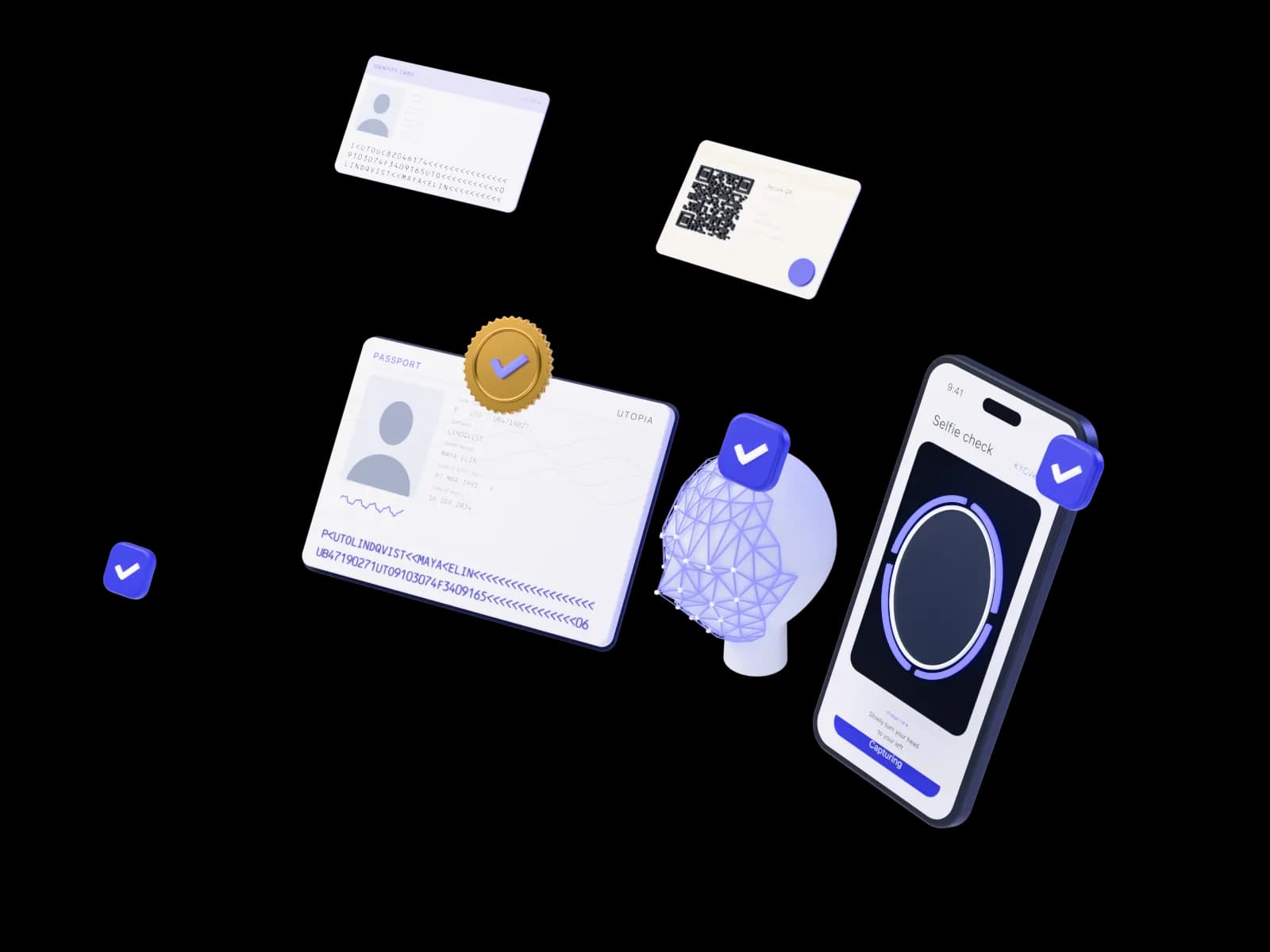
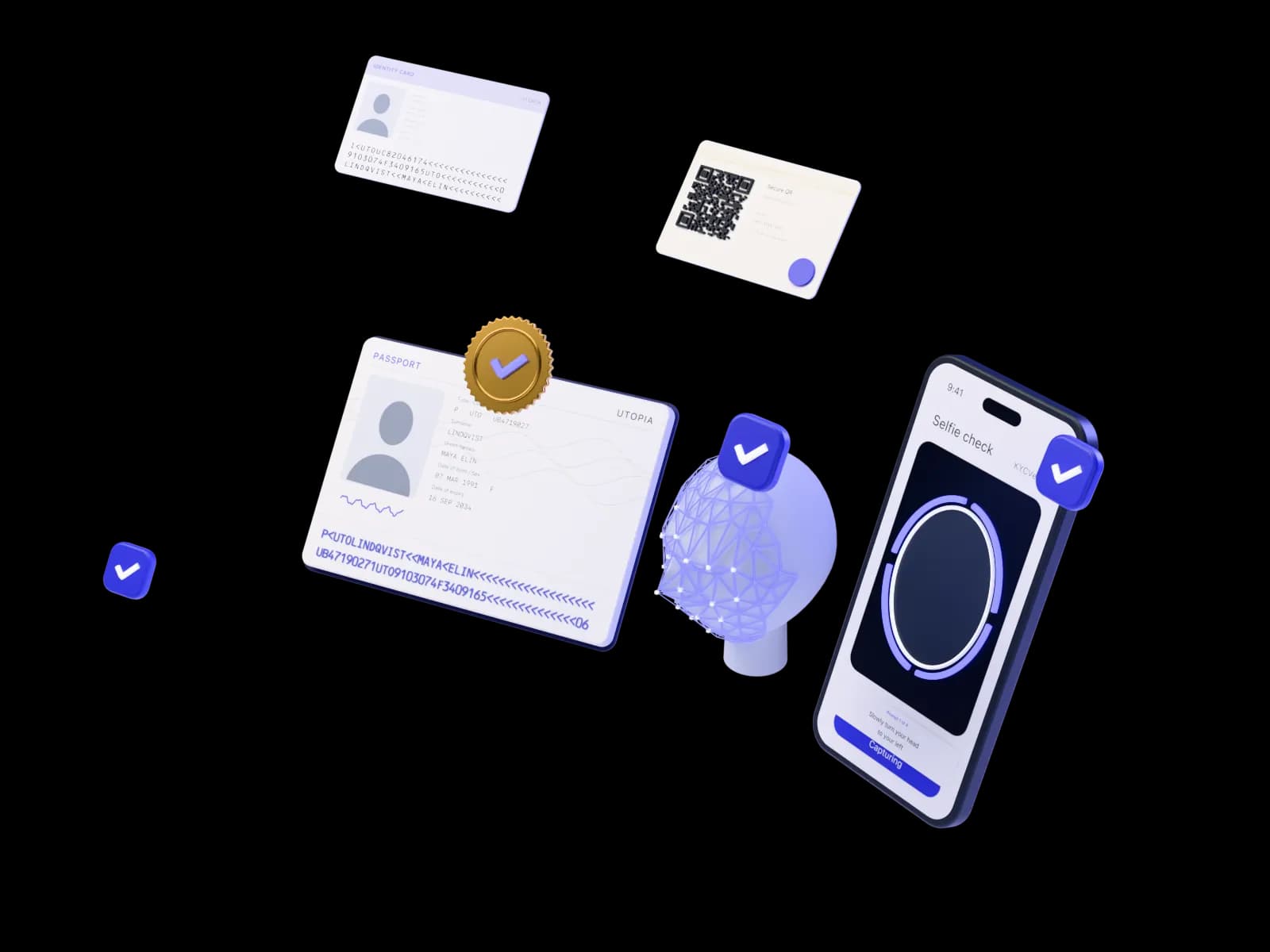
A session, start to finish
What the person sees. What your team sees.
The hosted flow on the left is the page your users open. The console on the right fills in as each step finishes, and the decision reaches your backend as a signed event. The screens, strings and statuses below are the product's own.
Hosted flow/verify/q3Xf…
Before you start
Your app uses KYCVerify to confirm your identity. Here is what happens with your information.
What we collect
- Photos of your identity document and the details printed on it
- A short sequence of selfie photos to confirm you are present
- Technical details of this device and connection (IP address, browser) to help prevent fraud
Secured by KYCVerify
Console · Sessions
ses_01JD7Q8YB6N2Z3K4M5P6R7S8T9
full_name
—
date_of_birth
—
document_type
—
document_number_masked
—
nationality
—
expiry_date
—
Checks0 of 6
- documentwaiting for the step
- livenesswaiting for the step
- face_matchruns on submit
- amlruns on submit
- duplicateruns on submit
- ipruns on submit
Timeline
- session createdPOST /v1/sessions
- consent recordedtime, ip, user agent
- document check writtenpassed · 0.97
- liveness check writtenpassed · 3 challenges
- submittedbackground checks run
- webhook delivered200 · attempt 1
Webhook session.status_updated is sent on every status change.
How it works
One call to start. One signed event to finish.
There is no SDK to embed and no verification UI to build. Your backend creates a session, the person follows a link, and the decision comes back to you.
- 01
POST /v1/sessionsCreate a session
Your backend asks for a verification with your own reference and an optional workflow. KYCVerify returns a one-time link and a session id. Test and live keys are separate, so the sandbox never touches production data.
x-api-keyheader, test or livevendor_dataties it to your user- Link expires after 7 days by default
- 02
/verify/{token}The person verifies
Consent, an optional email code, the document or Aadhaar, PAN, then the selfie challenges, on any phone or laptop browser. A desktop visitor can hand off to their phone with a QR code. Nothing to install.
- Steps chosen by the workflow
- Quality gate before every read
- 3 attempts per step by default
- 03
session.status_updatedYou get a signed decision
Background checks run on submit: face match, sanctions, age, duplicates, IP. The decision rule is applied and the result is posted to your webhook, signed with HMAC-SHA256 and retried until your server says 2xx.
- Approved, declined or in review
- Every check with its evidence
- 8 attempts with backoff
What it verifies
Ten check kinds. One decision with its evidence.
Each check returns a status, a score where one exists, and the warnings behind it, so anyone reviewing a decision can see exactly why it was reached.
- ICAO 9303
Identity documents
Passports, ID cards and residence permits read through the MRZ, every check digit recomputed, expiry and issuer enforced. Indian cards read by OCR.
- Active
Liveness
Random head-turn, smile and move-closer challenges, analysed frame by frame.
- 1:1
Face match
The selfie against the document or Aadhaar portrait, score kept as evidence.
- UIDAI
Aadhaar, offline
Secure QR and Offline e-KYC verified against UIDAI's signature. The signed formats carry only the last four digits.
- Structural
PAN
Format, holder type and name initial, with an optional card cross-check. No government lookup.
- OFAC · UN
AML screening
OFAC SDN with aliases and the UN consolidated list, order-insensitive fuzzy matching with date of birth.
- Fingerprints
Duplicates
The same document or face, seen before in your app, sends the check to review.
- 3 checks
Age, email and IP
A minimum age from the verified birth date, a 6-digit email code, and the client IP and user agent on record.
- No code
Workflows and review
Choose the steps and thresholds per use case. Anything uncertain lands in a review queue with all the evidence beside it.


Built for India
Aadhaar and PAN, verified the way they were designed to be.
UIDAI signs Aadhaar's offline formats. KYCVerify checks that signature with UIDAI's own public certificate instead of trusting a photo of a card, validates PAN's structure, and from the signed formats keeps only the last four Aadhaar digits.

- Aadhaar Secure QRRSA signature verified with UIDAI's certificate.
- Offline e-KYC XMLXML-DSig verified; share-code ZIPs opened.
- PANFormat, holder type and name initial. No lookup.
- DPDP-mindedMinimum kept, encrypted, purged on schedule.


KYCVerify verifies UIDAI-signed offline artefacts; it is not Aadhaar authentication. Offline verification requires OVSE registration with UIDAI, which software cannot confer. Regulatory notes
For developers
Three calls. One signature to check.
Plain HTTPS and JSON, a documented error envelope, and webhooks you can verify in ten lines. Nothing to install on the client.
Signature scheme
v1=hex(HMAC-SHA256(secret, "{timestamp}.{raw_body}"))
- x-kyc-event
- session.status_updated
- x-kyc-delivery
- whd_0k3v9z7c2b…
- x-kyc-timestamp
- 1767225600
- x-kyc-signature
- v1=5f2c…
Retries until 2xx
8 attempts
- now
- +30 s
- +2 min
- +10 min
- +30 min
- +1 h
- +3 h
- +6 h
The queue lives in the database, so a restart never loses a delivery. Any delivery can be resent from the console.
POST /v1/sessions
curl -X POST https://kycverify.me/api/v1/sessions \
  -H "x-api-key: $KYC_API_KEY" \
  -H "content-type: application/json" \
  -d '{
    "vendor_data": "user-42",
    "contact": { "email": "anna@example.com" }
  }'
Response
201 Created
{
  "session_id": "ses_0k3v9x2m4a7qhd8f1rtb",
  "status": "not_started",
  "url": "https://kycverify.me/verify/q3Xf…",
  "session_token": "q3Xf…",
  "workflow_id": "wf_0k3t1c8n5e2wpzr6g4ya",
  "vendor_data": "user-42",
  "expires_at": "2026-10-10T09:12:44Z"
}
Security
Identity data, encrypted and kept only as long as you say.
Every check runs on KYCVerify's own engine: no third-party verification API and no external model API sees your users' documents or faces. Uploads are encrypted at rest, each organisation's data is isolated, and a retention worker purges evidence on schedule.
KYCVerify
kycverify.me
- Rust APIaxum · SQLite
- Vision modelson CPU, in-process
- Sanctions indexOFAC SDN · UN
- Encrypted storageAES-256-GCM


No third-party verification or model API.
- every upload, encrypted at rest
- AES-256-GCM
- console passwords
- Argon2id
- API keys and tokens stored hashed
- SHA-256
- owner, admin, reviewer, viewer
- 4 roles
Compared honestly
Other vendors do more. Here is what we can show.
Mature KYC products have features KYCVerify does not. We compare only what is published and checkable: webhook signing, check types, Aadhaar offline verification and the decision data you get back.
What other vendors offer that KYCVerify does not
- NFC chip reading of e-passports and eIDs
- Passive liveness, and PAD certification from an accredited lab
- PEP lists, adverse media and ongoing AML monitoring
- Government and bureau database lookups in many countries
- Business verification (KYB)
KYCVerify
- Webhook signing
- HMAC-SHA256 over the timestamp and the raw body (x-kyc-signature), 5-minute replay window
- Webhook retries
- 8 attempts with backoff from 30 s to 6 h, persisted; redeliver from the console
- Aadhaar offline signature verification
- Yes: Secure QR and Offline e-KYC XML, UIDAI signatures verified
- Default retention
- 90 days per app (1 to 3,650), then purged
Didit
- Webhook signing
- HMAC-SHA256: X-Signature-V2 over canonical JSON, or X-Signature over the raw body; 300 s window
- Webhook retries
- Retried twice (about 1 min, then 4 min later) on 5xx, 404 or timeout, then dropped; replay from the console
- Aadhaar offline signature verification
- Not live (per its docs)
- Default retention
- Indefinite unless configured (30 days to 10 years)
Public sources as of 3 October 2026, linked on the comparison page.
| Topic | KYCVerify | Didit |
|---|---|---|
| Webhook signing | HMAC-SHA256 over the timestamp and the raw body (x-kyc-signature), 5-minute replay window | HMAC-SHA256: X-Signature-V2 over canonical JSON, or X-Signature over the raw body; 300 s window |
| Webhook retries | 8 attempts with backoff from 30 s to 6 h, persisted; redeliver from the console | Retried twice (about 1 min, then 4 min later) on 5xx, 404 or timeout, then dropped; replay from the console |
| Aadhaar offline signature verification | Yes: Secure QR and Offline e-KYC XML, UIDAI signatures verified | Not live (per its docs) |
| Default retention | 90 days per app (1 to 3,650), then purged | Indefinite unless configured (30 days to 10 years) |
Solutions
One engine, configured per use case.
Each solution is a workflow: the steps a person completes and the checks that decide.
Fintech and lending
Borrower onboarding with Aadhaar, PAN, liveness and sanctions screening, with evidence behind every decision.
Crypto exchanges
Passport-grade document checks and sanctions screening before the first deposit.
Marketplaces and gig
Verify sellers, hosts and drivers once, and stop banned users from returning.
HR onboarding
Identity checks for new hires and contractors, before day one.
Telecom and SIM
Subscriber identity with liveness and face match against the document or Aadhaar photo.
Gaming and age
Minimum-age gates backed by a real document and a live person.


FAQ
Questions, answered plainly.
Something else? Ask us.
Is KYCVerify a hosted service?
Yes. KYCVerify runs at kycverify.me: your backend calls https://kycverify.me/api, people verify at kycverify.me/verify/{token}, and your team uses the console there. Every check runs on KYCVerify's own engine, uploads are encrypted at rest with AES-256-GCM, and each app's evidence is purged after its retention period.
What can it verify?
Passports, ID cards and residence permits through the ICAO 9303 MRZ; Aadhaar, PAN, voter ID and Indian driving licences by OCR; Aadhaar Secure QR and Offline e-KYC against UIDAI signatures; active liveness; face match; sanctions screening against OFAC SDN and UN lists; minimum age; duplicates; email ownership.
What does it not do?
No NFC chip reading, no certified passive liveness, no PEP or adverse-media screening, no KYB, no phone OTP, no government database lookups and no native SDKs. We would rather you know now. The comparison lists it all.
Is the liveness check certified?
No. It is active challenge-response (turn left, turn right, smile, move closer) analysed frame by frame on KYCVerify's engine, and it is labelled as such. It has not been tested by a presentation-attack-detection lab.
How does my backend get the result?
A session.status_updated webhook signed with HMAC-SHA256 for every status change, carrying the full decision when the session is final. You can also call GET /v1/sessions/{id}/decision at any time.
Do people need to install an app?
No. The hosted flow runs in the browser on any modern phone or laptop and uses the device camera.
How long is data kept?
Each app has a retention period, 90 days by default. A worker purges the files, face embeddings and identity data of older sessions automatically, and you can purge any session on demand with DELETE /v1/sessions/{id}.
Does it handle Aadhaar numbers?
The offline formats (Secure QR and Offline e-KYC XML) contain only the last four digits, so that is all they give you. If a workflow also accepts a photographed Aadhaar card, the number is read to validate it and kept only masked and as a keyed fingerprint; the card image, which shows the full number, stays encrypted until the retention purge.
Start in the sandbox today.
An organisation, a sandbox app, test keys and a default workflow are created when you sign up.
curl -X POST …/v1/sessions -H "x-api-key: …"
201 Created · status not_started
url → /verify/q3Xf…